
Financial Organization
Getting your finances in order can feel like trying to drive 70 miles per hour on a busy freeway with no lane markers—chaotic and a bit stressful. But just like straightening up your home before guests arrive, organizing your money helps your mind function at its best and helps you focus on what is most important in your life.
Here is a simple, actionable guide to transforming your "box of paperwork" into a clear financial roadmap.
Step 1: Take an Inventory
Before you organize, you need to know what you have. Make a list of every "financial touchpoint" in your life.
- Assets (What you own): Bank, investment, and retirement accounts; your vehicles; and valuable personal property like jewelry or collectibles including income benefits like Social Security and pension payment statements.
- Liabilities (What you owe): Credit cards, mortgages, and any personal, car, or boat loans.
- Safety Nets: All insurance policies, including life, homeowners, health, disability, and long-term care.
- Other: Taxes and Estate Planning Documents. Tax returns (think about keeping at least 3 years worth) and all estate planning documents like wills, living trust, financial and healthcare powers of attorney, living wills and guardianship documents.
Step 2: Set Up Your Digital Filing Cabinet
You need a secure, private place online (cloud storage) to keep your digital files. Look for a service that prioritizes security and privacy to keep your information safe.
Step 3: Create Your Folder Structure
To stay organized, set up the following folders on your secure drive. Think of this as the "skeleton" for your digital files:
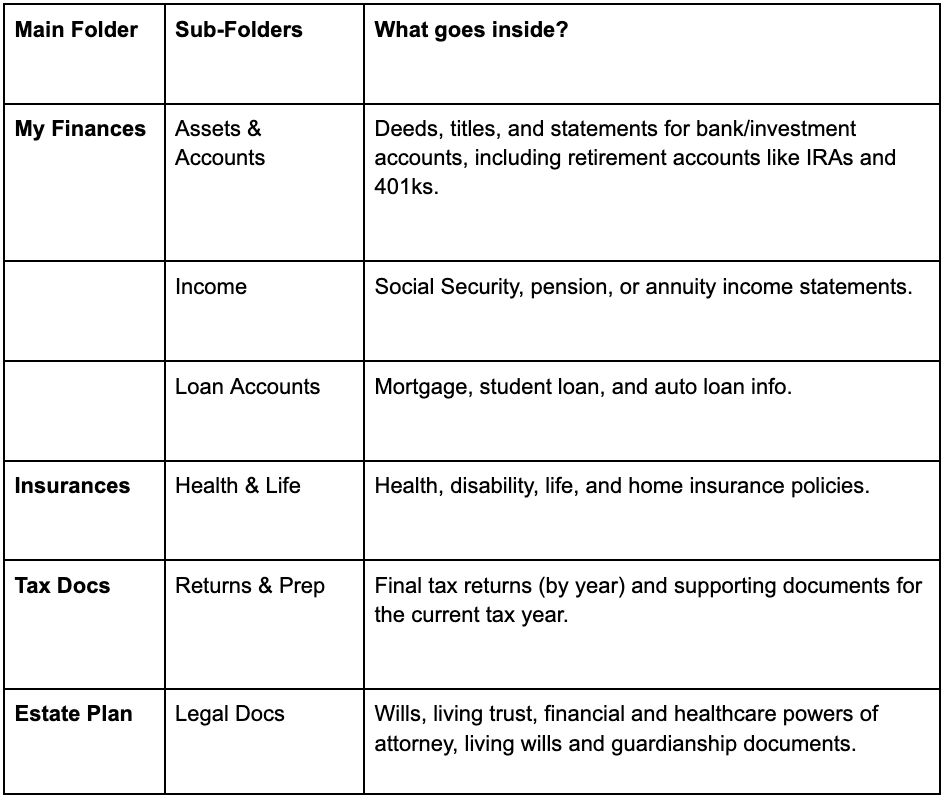
Step 4: Scan and Name Your Documents
If you have stacks of paper, it is time to digitize them.
- Get a good scanner: High-quality options like the ScanSnap iX1500 or iX1300 make this much faster and are a great investment into getting financially organized.
- Name files clearly: Don’t just name a file "Statement." Use a specific format so you can find it later.
- Example: "Chris Schwab IRA Rollover May 2026 Stmt".
- Sort as you go: Keep a separate pile for items already scanned so you don't get confused.
Step 5: The Simple Shred System
Once a document is scanned, named, and saved in the correct folder, shred it. This eliminates physical clutter and ensures your private information is discarded properly. Invest in a reliable shredder to make this a permanent habit. Here is a similar shredder Hurley Wealth is currently using: https://a.co/d/0iJCk9Sd
Pro Tip: Don't let the "stack" overwhelm you. Go slow, take it one step at a time, and you will eventually have a well ordered financial house.